
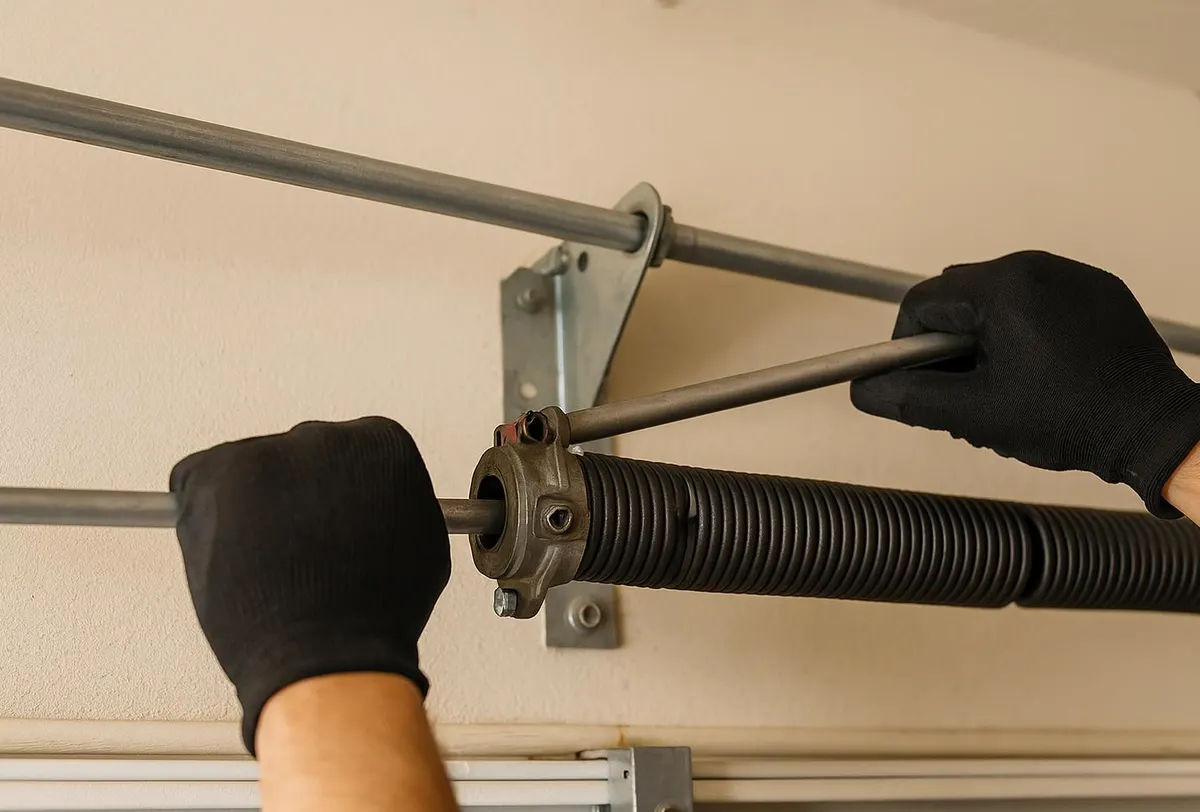
If your garage door has jumped its track, the rule is simple: stop touching the door and the opener, and leave the spring and cable system alone until a technician looks at it. The exceptions are narrow—mainly cases where the door is fully down, not under any visible tension, and a single roller has slipped just enough that a careful, gentle nudge by hand could reseat it. Everything else on a derailed door should be treated as loaded and unpredictable, even if it looks still.
What Actually Goes Wrong
A garage door comes off its track for a handful of reasons: a roller wears out and pops free, the track gets bent from an impact (a car bumper, a ladder, a stray basketball), or a cable frays and lets one side of the door drop unevenly. Once a door is off-track, the torsion or extension springs that normally lift it in a controlled way are still under tension, but that tension is no longer being managed by the track and rollers the way it's designed to be. That's the part people underestimate—the door looks like a simple mechanical problem, but the stored energy in the spring system is still live.
How Bad It Can Get
A door that's partially derailed can fall suddenly if a cable gives way, a roller lets go entirely, or someone tries to force it closed. A falling section can crush a hand, trap a pet, or total a car parked underneath. Cables under tension can snap back with enough force to cause serious cuts. Bent tracks that get forced back into place without proper alignment tend to fail again within weeks, often at a worse moment. None of this requires anything exotic to happen—it just requires someone to treat a stuck or crooked door as a quick DIY fix instead of a loaded system.
What to Do Immediately
- Stop operating the door. Don't hit the opener button again, and don't try to pull it up or down by hand.
- Disconnect the opener only if it's safe. If the door is down and not under obvious strain, pull the emergency release cord so the opener can't engage again accidentally. If the door is partway up or looks like it's being held by something other than the track, leave the opener connected and don't touch it at all—disconnecting could let the door drop.
- Clear the area. Keep kids, pets, and vehicles out of the door's path. Treat the space in front of and under the door like it's still moving, even if it looks settled.
- Look, don't lean. From a few feet back, check for a bent track, a dangling cable, a visibly bowed spring, or a roller sitting loose on the floor. This helps the technician diagnose faster over the phone and in person.
- Use another entrance. If you need to get a car out or get into the garage, use a side door or the interior door into the house rather than forcing the garage door.
- Take a few photos. Pictures of the track, rollers, and cables help a technician bring the right parts on the first visit instead of a second trip.
What Not to Touch
- Torsion and extension springs. Even a spring that looks broken or slack can release stored force. This is the single most common cause of serious garage door injuries, and it's not a DIY repair.
- Lift cables. A frayed or loose cable under load can snap back hard. Leave it exactly as you found it.
- The track itself. Bending it back "close enough" by hand almost always leaves it slightly misaligned, which wears rollers faster and can cause a repeat derailment.
- The opener, if the door is mid-cycle. Don't try to reverse it, override it, or manually force the door the rest of the way.
The one exception worth mentioning: if the door is fully closed, the opener is disconnected, and a single roller has slipped just off the edge of the track with no visible bend or tension anywhere, some homeowners can carefully guide that roller back in with gloved hands. If there's any bend in the track, any looseness in a cable, or any doubt at all, stop and call for service instead.
Why This Shows Up More in This Area
Jefferson's mix of heavy rain, pine debris, and humidity plays a bigger role in track problems than most homeowners expect. Pine sap and pollen build up on rollers and tracks and attract grit, which makes rollers bind instead of rolling smoothly—binding is a common precursor to a roller jumping the track. Moisture swings corrode track bolts and hardware over time, loosening the alignment just enough that a door that's operated fine for years suddenly doesn't. And as the weather turns toward the occasional ice storm later in the season, metal track brackets can contract and shift slightly, which is when marginal alignment issues tend to turn into an actual derailment. A door that's been slightly off for weeks often finally gives during the first cold snap.
When to Call Jefferson Garage Door
Call as soon as the door is off-track, even if it still looks like it's hanging on. Jefferson Garage Door handles this as a standard garage door repair call—realigning or replacing bent track sections, swapping worn rollers, and checking cables for fraying before anything is put back under load. If the spring is also compromised, which is common when a door has been forced or has dropped suddenly, that gets handled as a separate spring replacement, done with the proper tools to release and reset tension safely. We serve Jefferson, Winder, Braselton, Hoschton, Commerce, Nicholson, Pendergrass, and Talmo, and we can usually get someone out quickly once a door is off its track, since it's not something that's safe to leave for later.
If your garage door has come off its track anywhere around Jefferson, GA, stop using it and give Jefferson Garage Door a call—we'll get it back on track safely and check the rest of the system while we're there.