
The Mistake Almost Everyone Makes First
When a garage door starts squeaking, the instinct is to grab whatever spray can is already sitting on the shelf, usually WD-40, and hit every moving part until the noise stops. It's tempting because it's cheap, it's already in the garage, and it does quiet things down for a week or two. The problem is that WD-40 is a solvent and water displacer, not a lubricant. It strips away whatever grease was already protecting the metal, and then it evaporates, leaving bare hardware exposed. In a area with heavy rain, high humidity, and pine pollen drifting into open garages for months at a time, that bare metal starts collecting grit almost immediately. The squeak comes back faster and often louder, because now you've got dry metal grinding against dust.
Tools and Products You'll Need
- A silicone-based or lithium-based garage door lubricant (sold specifically for garage doors, not household oil)
- Clean rags or shop towels
- A soft-bristle brush or a vacuum with a brush attachment
- A sturdy step ladder
- Work gloves and safety glasses
Spend the extra few dollars on a lubricant labeled for garage doors. These are formulated to stay put through temperature swings, from humid summer afternoons to the occasional ice storm, without drying out or gumming up.
Step-by-Step: How to Lubricate Your Garage Door
- Disconnect the opener and close the door manually. Pull the red release cord so the door is under manual control, and close it the rest of the way by hand. This keeps the opener from cycling while you're working.
- Clean before you lubricate. Wipe down the tracks, hinges, and rollers with a dry rag first. If pollen or dirt has built up into a film, which happens fast in spring but lingers into fall after storms, use the brush or vacuum to clear it out. Lubricating over grime just creates a sticky paste that attracts more dirt.
- Lubricate the hinges. Apply a light coat to the pivot points on each hinge, where metal meets metal. Open and close the door a few times to work it in, then wipe off anything that drips.
- Lubricate the rollers. If your rollers have ball bearings, apply lubricant to the bearing area, not the roller wheel itself. If you have plastic or nylon rollers without bearings, they generally don't need lubrication at all.
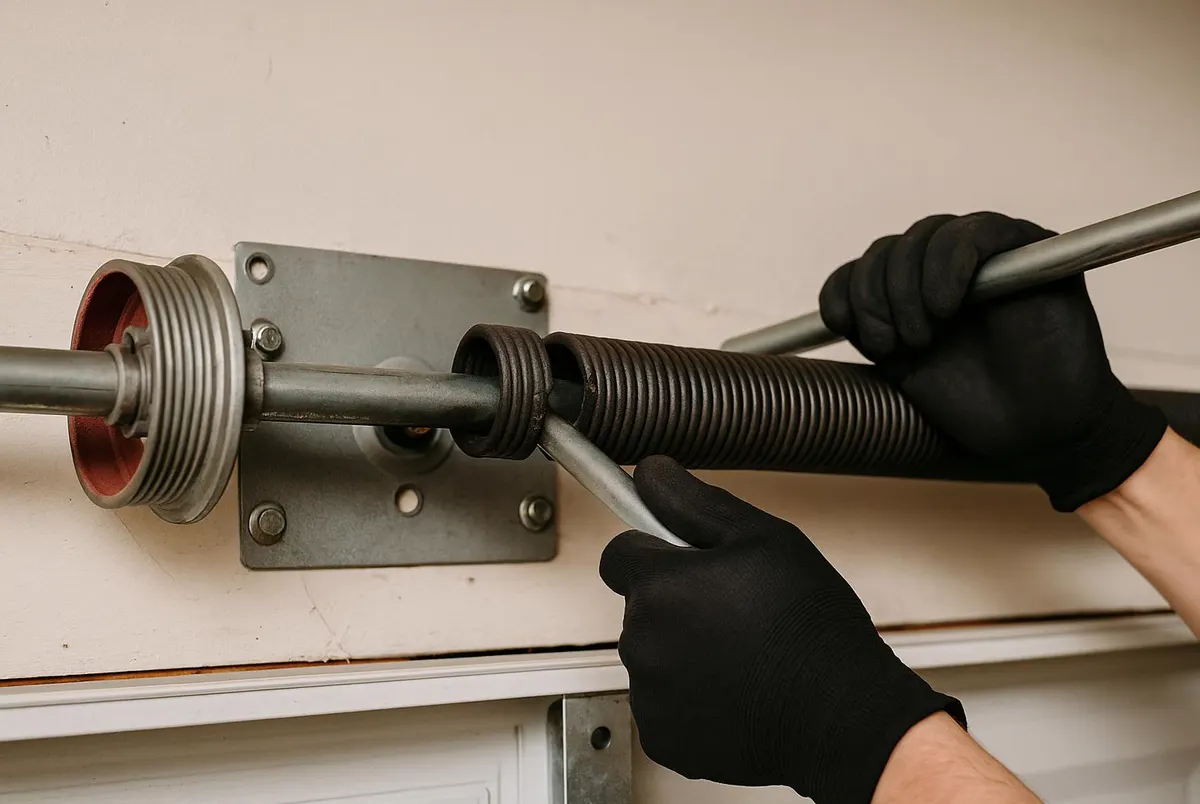
- Lightly coat the springs. A thin film of lubricant on the torsion or extension springs helps prevent rust, which is a real issue here given the humidity and rainfall. Do not attempt to adjust, stretch, or remove the springs. Lubricating is fine; touching the tension is not.
- Lubricate the opener's chain or screw rail. Check your opener's manual, since chain-drive and screw-drive systems take different products. A few drops along the length, worked in by running the door, is usually enough.
- Do not lubricate the tracks. This surprises a lot of people, but the tracks should only be cleaned, never greased. Lubricant on the track attracts debris and can make the rollers slip instead of roll smoothly.
- Reconnect the opener and test the door. Run it up and down a few times, listening for any remaining grinding or squeaking. Wipe away excess lubricant so it doesn't drip onto the garage floor or attract dust.
What to Avoid
- WD-40 and similar penetrating oils — good for loosening rust, bad for long-term lubrication.
- Household oils like 3-in-1 or motor oil — too thin, they run off quickly and don't hold up to heat.
- Heavy grease, such as axle or wheel bearing grease — too thick for garage door hardware, and it becomes a magnet for pine pollen and dust.
What a Homeowner Can Handle vs. What Needs a Technician
Cleaning and lubricating hinges, rollers, and the opener rail is well within reach for most homeowners with basic tools and a free afternoon. What's not a DIY job is anything involving spring tension, cable adjustment, or realigning a track that's bent or pulled away from the wall. If you're lubricating the springs and notice one looks stretched, rusted through, or uneven compared to the other, that's a sign of wear that lubrication won't fix.
When to Call Jefferson Garage Door
If you've gone through this routine and the door still grinds, hesitates, or sounds uneven, the issue is likely mechanical rather than a lubrication gap. That's when it's worth calling in a technician rather than reaching for another can of spray. Jefferson Garage Door offers Preventive Maintenance visits that cover a full inspection of springs, cables, rollers, and the opener, catching the kind of wear that's hard to see from a ladder. If a spring has already failed or looks compromised, our Spring Replacement service handles that safely, since torsion springs carry enough tension to cause serious injury if handled incorrectly.
Fall is a good time to get ahead of it, before winter ice storms stiffen up worn hardware and before the next round of heavy rain finds its way into a garage that's already struggling. If your garage door in Jefferson, Winder, Braselton, Hoschton, Commerce, Nicholson, Pendergrass, or Talmo needs more than a fresh coat of lubricant, give Jefferson Garage Door a call and we'll get it running quietly again.